I have watched a lot of videos lately of people testing exercise on their glucose monitors. The usual set-up is simple. They eat the same meal on two different days. On one day they sit still afterwards. On the other day they do something: 50 bodyweight squats, 50 calf raises, or a three-minute wall sit, sometimes with a short rest in the middle. Then they compare the two blood sugar curves, and the day with movement usually comes out lower.
A few of them went further and tested exercise before or after a meal, to see which timing works better. That is the question I wanted answered too. So I looked at what the research says about both.
What these videos can and cannot tell you
I like these videos. They show something real, in a way a research paper never will. But it helps to know what one person’s test can prove.
Your blood sugar does not respond exactly the same way to the same meal every day. Sleep, stress, what you ate the night before and how active you were earlier all change the curve. So one day against one other day, in one person, is a hint, not proof. What makes me take the videos seriously is that they point the same way as the studies below.
If you are not sure what your own readings mean, I put together a free guide to understanding your blood glucose numbers.
Moving after a meal
This is the side with the most research behind it, and I covered part of it in the post on 10 squats every 45 minutes. The short reason it works: muscles that are working pull sugar out of your blood on their own, without waiting for insulin to do the job.
One of the most practical studies came out this year. Researchers in Canada asked 31 people with Type 2 diabetes to do one-minute bursts of exercise four times a day, usually within an hour after their meals. The exercises were simple: stepping up and down, running on the spot, or standing up from a chair and sitting back down. They did it in their normal daily lives, not in a lab. Compared with days without the bursts, their blood sugar after breakfast and dinner was lower. The researchers called the improvement small, but it was real, and it came from four minutes a day.
An older study in people with Type 2 diabetes compared the same resistance workout done before dinner and after dinner. After dinner, the rise in blood sugar was 30% smaller than with no exercise. Before dinner, it was 18% smaller. The difference between the two was not statistically clear, so both helped.
Moving before a meal
Before-meal exercise gets less attention, but it has its own evidence. In a 2014 study, people with insulin resistance did six one-minute bursts of brisk uphill walking about 30 minutes before each meal. On another occasion they did one 30-minute walk before dinner instead. The short bursts before every meal gave them a lower average blood sugar over the whole day.
One thing to know about that study: the bursts were hard, close to the participants’ maximum heart rate. It was also small, with only nine people. So I read it as “moving before meals helps too”, not as a routine to copy exactly.
So which is better?
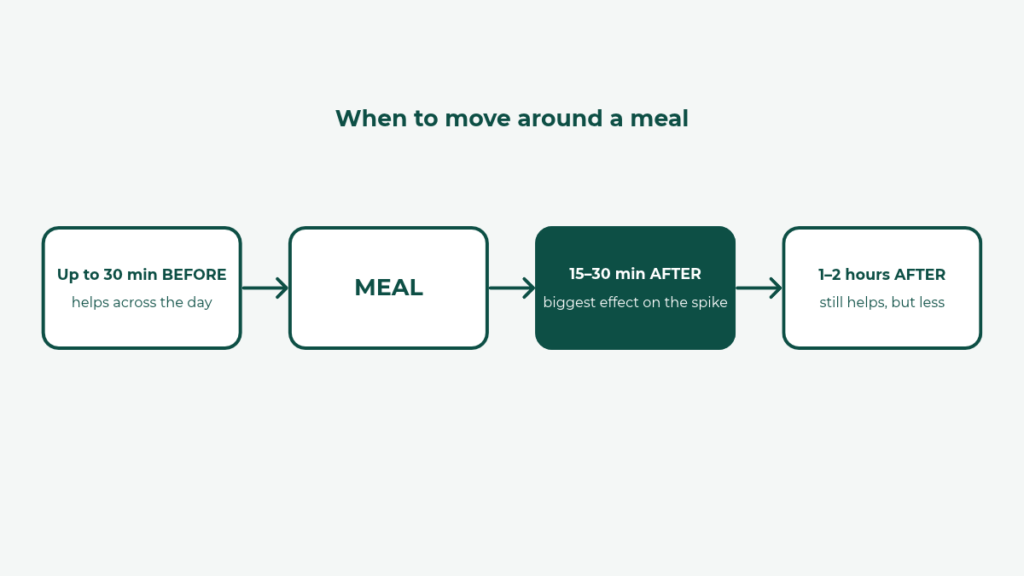
In 2023, researchers pooled eight trials, including people with Type 2 diabetes. For the rise in blood sugar after a meal, exercise after eating worked better than exercise before, and the sooner after the meal, the stronger the effect. Exercise before the meal did not clearly lower that particular rise.
A larger 2024 review, pooling 28 studies, adds an important detail. Over a whole day, and over several weeks of doing it regularly, the difference between before and after mostly disappeared.
And in some of the glucose monitor videos I have watched, people who moved just before eating did see a smaller rise afterwards. That is one person on one day, so it is not proof, but it lines up with the studies that found benefits from moving before meals.
So for me it works like this. After a meal is the better choice when I can manage it. Before a meal still counts. And doing both is better still.
What counts as moving?
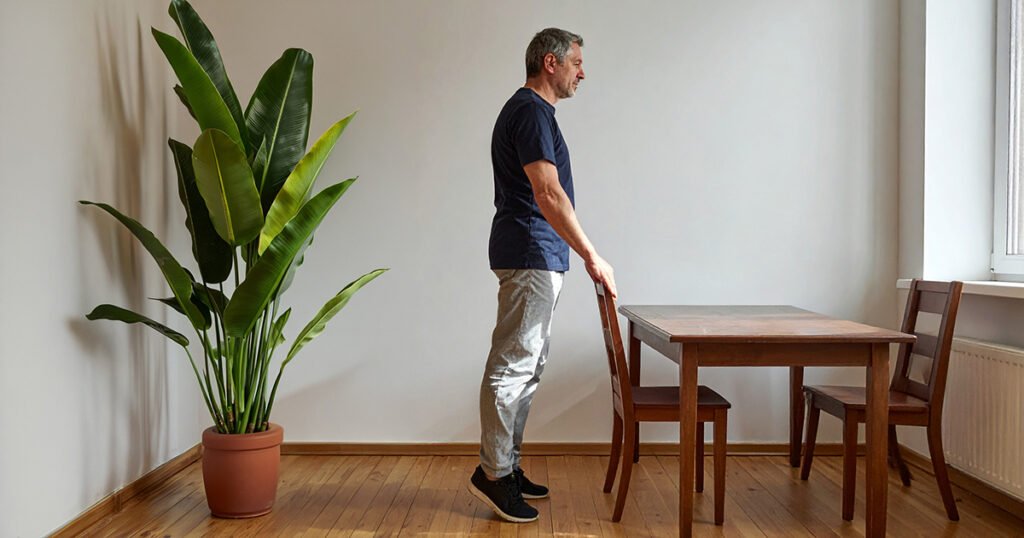
More than you might think. Squats, calf raises, a wall sit, a few trips up and down the one flight of stairs I wrote about last time, a short walk, or even washing up and tidying the kitchen. Not every one of these has been tested on its own, but they all get your muscles working. None of it needs to be done in one go. Splitting it into short sets with a breather in between is fine. Several of the studies used short bursts with rests, or bursts spread across the day.
One honest note on wall sits. I have seen several videos of people doing a three-minute wall sit after a meal and getting a smaller spike on their glucose monitor. The only study I could find that tested one after a meal was small, and in young, healthy adults. There, the wall sit lowered blood sugar a little, but not by enough to be statistically clear, and it was the exercise people found hardest. Walking did better.
Where wall sits really stand out is blood pressure. A 2023 review of 270 trials found that holding exercises like the wall sit lowered blood pressure more than any other type of exercise tested, by about 8 points on the top number. The routine is different from the after-meal version, though. In a 2026 trial, people with slightly raised blood pressure did four wall sits of about two minutes each, with two minutes’ rest in between, three times a week. After four weeks, the top number had dropped by about 9 points more than in people who did no training.
For someone like me, managing both blood sugar and blood pressure, that makes the wall sit worth keeping, just for a different reason than the videos suggest. I still do them sometimes after meals. If you hate them, a walk or calf raises will do at least as much for blood sugar.
What I actually do
My own routine is a mix. Most often, after a meal, I do around 50 calf raises or soleus pushups while I watch something, for maybe 10 to 20 minutes. Some days I go out for a 20 to 30 minute walk instead. Sometimes it is a wall sit. And some days I go straight from the table to the gym.
Before meals is less planned. If I remember, I do some standing calf raises before I sit down to eat. And if I am eating at a restaurant within walking distance, I make a point of walking there instead of driving. It is about six minutes each way, so I get a short walk before the meal and another one after it. Little pieces, but I believe they add up.
I have not measured any of this on my own glucose monitor yet. So, as with the stairs, I do it because the research points that way, not because my own numbers proved it.
Two safety points
If you take insulin or a medication that can cause low blood sugar, such as sulfonylureas, be careful with exercise before a meal. Exercising on an empty stomach can push your blood sugar too low. Talk to your doctor before you start, and keep an eye on your readings.
Wall sits and other holds push your blood pressure up while you are holding them. If your blood pressure is high or not well controlled, check with your doctor first, and don’t hold your breath while you hold the position.
The short version
Should you exercise before or after a meal? For the rise in blood sugar after eating, after wins. One review of the research suggests that people with Type 2 diabetes start moving about 30 minutes after they begin eating, which for most meals means soon after you finish. Before still counts: over a whole day, the gap between the two gets much smaller. And doing both is better still.
If you want to see how I structure my eating window around all this, it is in my 16:8 guide.
And if you want to run your own before-and-after test, the blood sugar tracker is the one I wish I had been keeping all along. Your body is not my body. The only way to know what this does for you is to watch your own numbers.
Sources
MEDICAL DISCLAIMER
I am not a doctor. I write from personal experience as someone managing Type 2 diabetes, and from reading the published research. Nothing here is medical advice. Speak to your doctor before making changes that could affect your blood sugar or medication.