
A claim has been going around: do 10 squats every 45 minutes and it lowers your blood sugar more than a 30-minute walk. It’s specific enough to sound like real science, and it is — it just isn’t what the number says. The study behind it never counted reps.
I sit for a living and I have Type 2 diabetes, which is exactly the audience this claim is aimed at. After the soleus pushup post, I said I’d keep going with this — simple things you can do at home that actually have research behind them. So I read the study the claim comes from, and then went looking for a second one — because the first was not done on people with Type 2 diabetes, and I am.
The claim going around
The claim traces back to a 2024 study from Finland, published in the Scandinavian Journal of Medicine & Science in Sports. Eighteen overweight or obese young men sat for eight and a half hours under four different conditions: uninterrupted sitting, one continuous 30-minute walk, ten 3-minute walking breaks spaced 45 minutes apart, and ten squatting breaks on the same schedule.
The broken-up conditions won. Both the walking breaks and the squatting breaks reduced the post-meal glucose curve more than sitting still or taking a single 30-minute walk — and the two of them performed identically to each other.
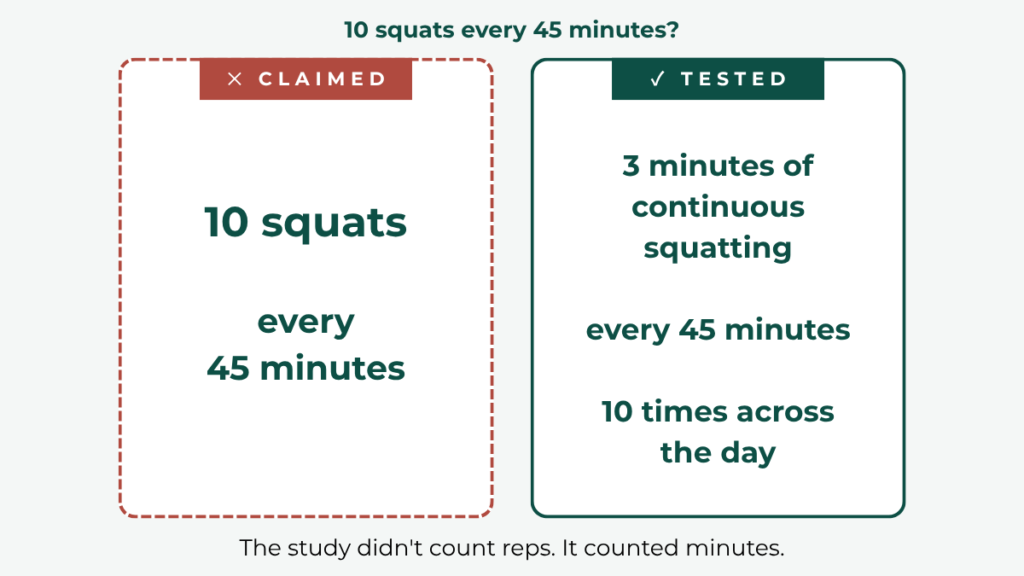
Where the claim goes wrong is the “10 squats” part. The study didn’t count repetitions at all. Each squatting break was a continuous three-minute bout of squatting — down, up, down, up, for three minutes straight, ten times across the day. That is a very different instruction to “do ten squats,” which most people read as ten reps and then sit back down. Even fitness influencers with large followings have repeated the “10 squats every 45 minutes” version when citing this exact study.
The study that actually matters more
Which brings me back to who was actually in that Finnish study: eighteen men averaging twenty-one years old, overweight but not diabetic. Useful data, and not really about people like me.
The study I’d point to instead is older and less viral, but it was done in actual Type 2 diabetics: twenty-four adults, mean age 62, all inactive and overweight, from a 2016 trial published in Diabetes Care. Over eight-hour sessions, three conditions were compared: uninterrupted sitting, three-minute bouts of light walking every 30 minutes, and three-minute bouts of simple bodyweight resistance activity every 30 minutes — no equipment, just bodyweight.
Both broken-up conditions cut the glucose curve by 39% compared with sitting still. Insulin dropped by 36–37% in both. Walking and simple resistance movements worked equally well — and this was in people who actually have Type 2 diabetes, tested against their own baseline of uninterrupted sitting rather than against a single continuous walk.
One study found the opposite
This belongs in here, because leaving it out would be the same trick I just accused the viral version of. In 2020 a trial did almost exactly what this post recommends — three minutes of bodyweight movement every thirty minutes, half-squats, wall press-ups, knee raises, calf raises — and found blood glucose came out higher on the exercise days than on the sitting days. Not lower. Higher, and statistically so.
So why am I still writing this? Because of who was in it. The twelve participants were healthy, normal weight, average age twenty-five, and diabetes was an exclusion criterion — nobody in that room had it. When your glucose control already works properly there is very little to improve, and the researchers’ own suggestion is that the body may have been releasing glucose to fuel the exercise itself. That is a reasonable thing for a healthy twenty-five-year-old’s liver to do. It is not the situation of a sixty-two-year-old with Type 2 diabetes whose post-meal curve climbs too high and stays there.
It is also twelve people, and the result only just crossed the line for statistical significance.
The honest conclusion is the same one this whole post is built on: look at who was in the study before you take the number home. That cuts both ways — against the viral claim, and against me.
Why interrupting sitting beats a workout later
The short version: contracting muscle pulls glucose out of your bloodstream on its own, without waiting for insulin to do the job. That’s true whether the contraction comes from a squat, a walk, or the soleus pushup I wrote about last time. What the studies above show is that spreading a small amount of movement across the whole sitting period beats saving it up for one block of exercise later — the same idea as last time, just with the rest of your body doing the work instead of only your calves.
Why this matters more than it sounds: insulin resistance — how your body’s response to insulin breaks down in the first place — is the mechanism sitting underneath everything in this series, and it deserves its own proper explanation rather than a paragraph here. I will write that one properly in a post of its own.
Does upper body count?
Worth answering, because it is the obvious question and none of the studies address it head-on. Every protocol described above used the legs — squats, calf raises, knee raises, walking.
The closest thing to an answer comes from a small trial in people with Type 2 diabetes that tested a mixed resistance circuit after a meal, including upper-body work with an elastic band. Every exercise condition in it lowered the post-meal glucose rise compared with sitting. But the circuit mixed arms and legs together, so there is no way to separate out what the arms contributed on their own. Eight people, too, so hold it loosely.
Here is how I understand it, and I want to flag that this is me reasoning rather than something a study measured. Curls and press-ups are not wasted — arms are muscle too. But your legs are a much larger share of your body’s total muscle than your arms are, so minute for minute, lower body almost certainly clears more sugar. If you are picking one, pick the legs. But by all means do curls if you enjoy it — that still beats sitting completely still.
The four movements
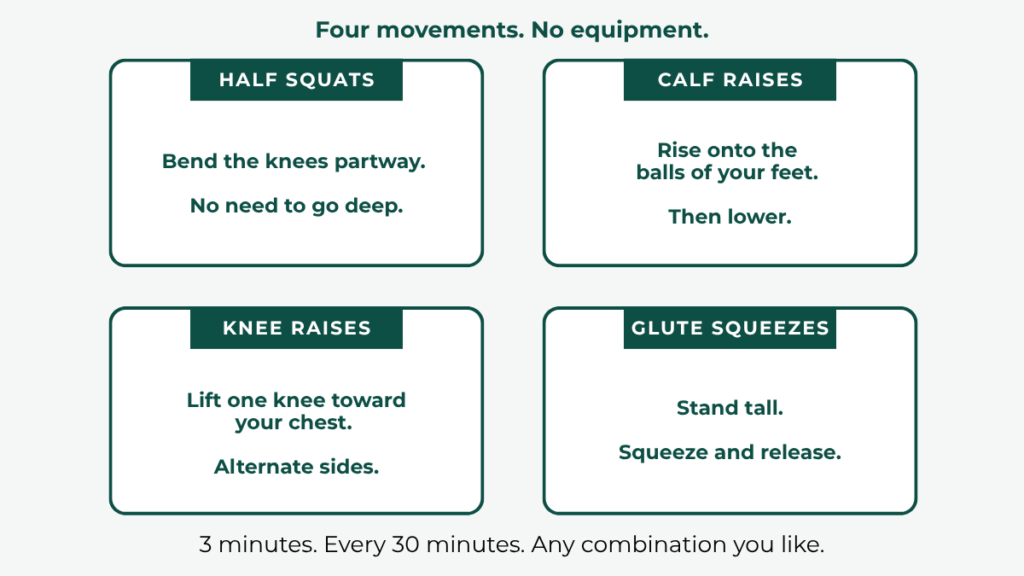
The resistance-activity protocol from the Type 2 diabetes study wasn’t one exercise — it alternated between four, in short 20-second rounds, adding up to three minutes:
Bodyweight half-squats. Feet shoulder-width, bend the knees partway — you don’t need to go deep or add weight. Stand back up.
Calf raises. Standing, rise onto the balls of your feet, then lower. Hold a wall or chair back for balance if you want it.
Knee raises. Standing, lift one knee toward your chest, alternate sides. Hold something for balance if needed.
Glute contractions. Standing or holding a chair back, squeeze the glutes briefly and release, repeatedly.
If light walking around the room suits your day better than any of these, the research says it works just as well.
So what should you actually do?
Here is the whole thing in one place.
Every 30 to 60 minutes, stand up and move for about three minutes. The studies used 30 minutes, and closer to 30 is probably better — but 60 still beats staying in the chair.
Mix the movements however you like. Any combination of the four above, plus marching on the spot, a lap around the house, or a few curls if there are dumbbells within reach. It does not have to be three solid minutes of squatting. The study protocol itself rotated through four different movements rather than sticking to one.
Keep it easy. None of it should be difficult or leave you out of breath. You are not training. You are just not sitting. If you find yourself counting reps or chasing a burn, it has turned into something it was never meant to be.
And if you’re already doing the soleus pushup while seated, this is what to do in between — they stack rather than compete. Between the two, more of your sitting day is covered than either one alone.
What about just 15 squats after a meal?
This is a fair question, and I want to give you an honest answer rather than a confident-sounding one: nobody knows. I looked for a study that tests a fixed number of squats — 15, or any other specific count — right after a meal, and it doesn’t exist. Every study on this topic, the two above included, measures time, not repetitions. Three minutes of continuous movement, not a rep count.
That doesn’t mean 15 squats does nothing. It just means nobody has actually tested whether 15 is the right number, too few, or more than needed. If you want to follow what’s actually been shown to work, the honest version is: do bodyweight squats, calf raises, or a similar movement continuously for a couple of minutes, rather than treating a specific number as a target that’s been proven. It’s a small shift in framing, but it’s the difference between what the research says and what sounds like it does.
What I actually do — which is not the protocol
I should be straight about this: I do not do the tidy version described above. Not consistently, anyway.
What I do is closer to a bodge. Instead of walking for twenty minutes after a meal, I will sometimes do twenty minutes of dumbbell work instead — bicep curls, tricep extensions, whatever I feel like that day — and then walk during the two or three minutes of rest between sets. Same twenty minutes. The rest periods are just doing something instead of nothing.
Then, if I have anything left, ten minutes on the rebounder in my backyard. Not a hardcore session, not gentle bouncing either — somewhere in between.
And on the way out to it, I do fifteen air squats. Not because fifteen is special. It is the number I settled on, and it is roughly how far it is to the rebounder.
Which is an awkward thing to admit in a post that just told you nobody has tested whether fifteen squats does anything. I picked that number exactly the way everyone else does — it felt about right. Writing this is how I found out there is no evidence for it in either direction.
Whether the dumbbell version does anything for blood sugar that the walk would not have, I genuinely do not know. Spreading the movement across twenty minutes rather than sitting still between sets is at least the same shape as what the studies did. But that is me reasoning, not evidence.
I have also never measured any of it. No week of readings with the breaks against a week without — I simply did not do it. I would still tell you to, though, because I know how much more useful this post would be if I had. I could be telling you what actually happened to my blood sugar, instead of what the research says should happen to it. That is the reason I made a printable tracker for exactly this. So take my experience for what it is: I do this because the research suggests it should help and it costs me almost nothing, not because my own numbers proved a thing.
And I have got worse at this, not better. Since starting physio twice a week I have less time and noticeably less energy, and these breaks are the first thing to go. Worth saying, because everything above makes it sound easy, and easy things still fall off when the day gets full.
Do not overthink it
Everything above is precise because the studies are precise. Don’t let that turn this into one more thing you have to get exactly right before it counts.
If you stand up every 40 minutes instead of 30, or do calf raises instead of squats because your knees don’t love squats today, or walk to the kitchen and back instead of doing a structured movement — that is still muscle contracting instead of a chair holding you still. The size of the studies here is small and the effects won’t be identical for everyone, but the downside of trying is close to nothing. Imperfect and repeated beats perfectly timed and abandoned by week two.
Two caveats worth keeping. This is not a replacement for medication, diet, or the exercise you’re already doing. And if you’re on blood sugar medication, keep an eye on your readings as you add more movement into your day — anything that improves glucose clearance can interact with your doses. That’s a conversation for your doctor, not a blog post.
Here’s the short version
The “10 squats every 45 minutes beats a 30-minute walk” claim is close to true, but the ten squats part is wrong. What the study actually tested was three minutes of continuous squatting every 45 minutes, ten times across the day — not ten repetitions and back into the chair. More importantly, that study wasn’t even done in diabetics. The one that was found the same pattern: three minutes of light walking or simple bodyweight movement, roughly every 30 minutes, cut post-meal glucose by close to 40% compared with sitting still, in actual Type 2 diabetics. Walking and simple resistance movements worked equally well. Nobody has tested a specific rep count like 15 squats, so treat that as unproven rather than as a rule.
If you want the fuller picture of what I’ve found actually works for managing blood sugar day to day, I wrote it all down in my guide.
I have made two printable trackers, both of them things I wish I had been keeping all along. One is for intermittent fasting. The other is for blood sugar and the rest of the numbers. Your body is not my body. The only way to know what any of this does to yours is to watch your own numbers — which is more than I did.
Sources
Bellini A, Nicolò A, Bulzomì R, Bazzucchi I, Sacchetti M. The Effect of Different Postprandial Exercise Types on Glucose Response to Breakfast in Individuals with Type 2 Diabetes. Nutrients, 2021;13(5):1440.
Chang Y, Wang H, Zhang X, Liu H. Acute effects of exercise snacks on postprandial glucose and insulin metabolism in adults with obesity: a systematic review and meta-analysis. Frontiers in Nutrition, November 2025.
I am not a doctor. I write from personal experience as someone managing Type 2 diabetes, and from reading the published research. Nothing here is medical advice. Speak to your doctor before making changes that could affect your blood sugar or medication.