There is a muscle in your lower leg that makes up about 1% of your body weight and can, under the right conditions, burn more carbohydrate than every other muscle in your body combined. That is not a wellness claim. It comes from a 2022 study at the University of Houston, published in the journal iScience, and the numbers are worth paying attention to.
The exercise built around it is called the soleus pushup, and it has spread widely on social media since. Most of what you will see does get the basics right — people generally teach it seated, which is correct. Where things drift is in the additions: that you can also do it standing, or that adding weight makes it more effective. Both of those change what the exercise actually does.
I have Type 2 diabetes and I sit for a living, so this is directly relevant to me. I read the study, then read the researcher’s own published answers to exactly these questions, then tried it myself — and found I had a couple of things backwards. My calves were tired after fifteen minutes when the research says they should not be, and I had assumed a small heel lift was safer when the study suggests otherwise. Both of those turned out to be useful, so they are in here too.
One thing up front: none of this means standing or weighted calf raises are bad exercises. They are excellent exercises, built for a different purpose. The researcher who developed the soleus pushup lifts weights daily and says so himself.
What the study found
The research came from Professor Marc Hamilton’s team at the University of Houston. Participants performed sustained soleus contractions while seated, and the researchers measured blood glucose and insulin after a standard 75-gram glucose drink.
Over the following three hours: a 52% improvement in blood glucose excursion and a 60% reduction in insulin requirement, with glucose already measurably lower within the first 30 minutes.
If, like me, you had to look up “glucose excursion” — it is how far your blood sugar climbs above baseline after eating, and how long it stays up. Picture the curve on a blood sugar graph: excursion is the size of the hill. So 52% does not mean your blood sugar halves. It means the hill was roughly half as big.
A separate 2025 pilot study in ten people with prediabetes found roughly a 32% reduction. Smaller, but from an independent group — and the effect held without the laboratory feedback equipment, which matters for anyone doing this at home.
Keep the scale in mind. These are small studies and this is early research, not settled science. Hamilton has also been open that the movement is harder to get right than it looks — in his words it “requires wearable technology and experience to optimize the health benefits.” Study participants wore sensors confirming the correct muscle was firing. At home you are working blind, which is exactly why that prediabetes result matters.
How it is actually done
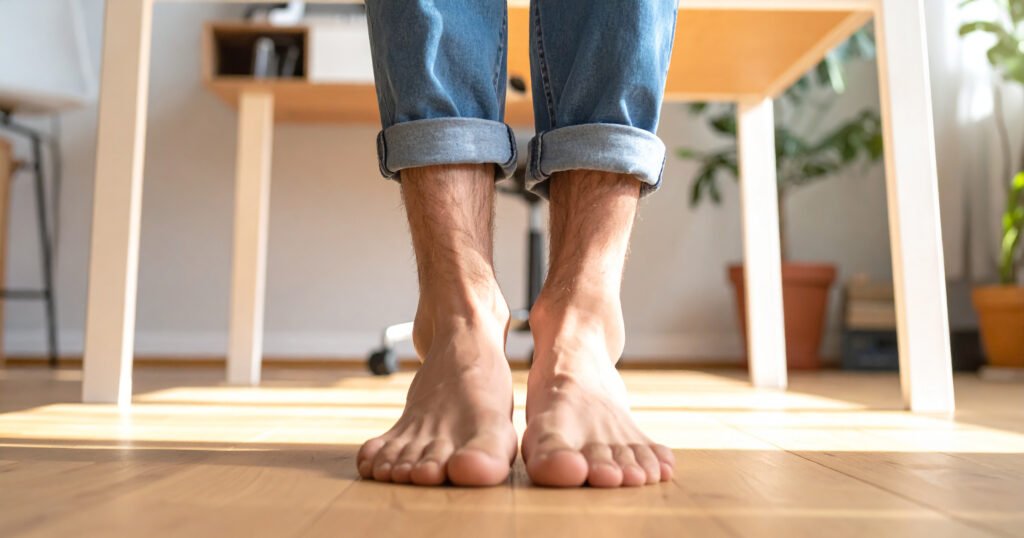
The University of Houston’s description is brief and precise: seated, feet flat on the floor, muscles relaxed, the heel rises while the front of the foot stays put. At the top of its range, the foot is passively released back down.
Four details matter more than they appear to.
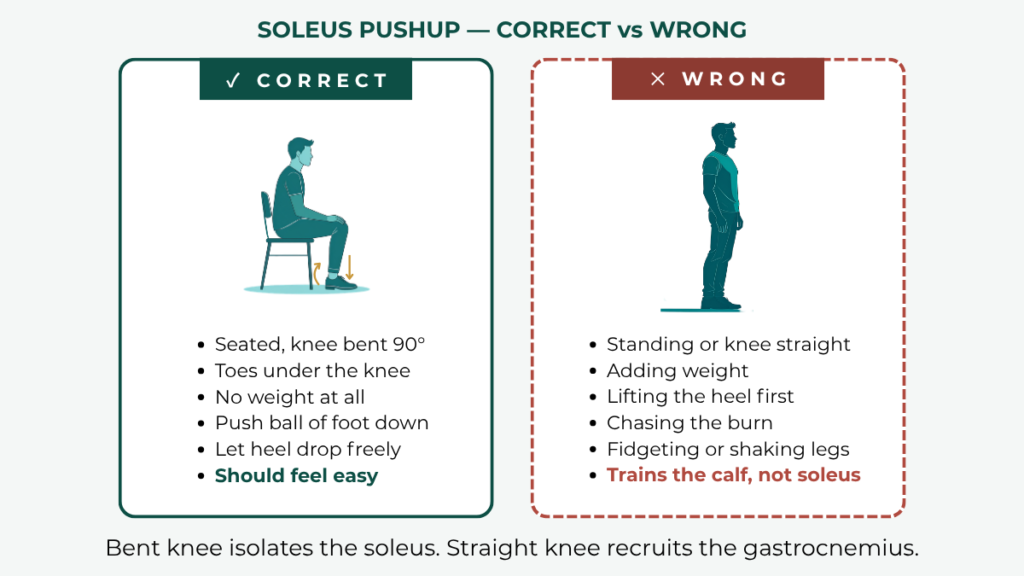
Push down at the ball of the foot. Do not lift the heel. This sounds like hair-splitting and it is not. Hamilton found that participants who consciously lifted their heels recruited the wrong muscles — same visible movement, different muscle doing it. Press the ball of your foot into the floor and let the heel come up on its own.
Let the push-down decide how high the heel goes. The study found that increasing range of motion raised soleus activity more than increasing speed did, so a full unhurried range beats a fast shallow one. But there is a caveat that took me a while to work out. When I push through the ball of my foot, my heel rises less than when I consciously lift it. I think “maximum range” means the maximum the soleus produces on its own — not the highest you can get your heel by any means. Lifting brings in the larger calf muscle, which gives more height precisely because more muscles are involved. It looks like a better repetition and is the wrong one. So: go to the top of what the push-down gives you, but never strain for extra height. If you feel strain, that is not a sign you are working harder — it is a sign the larger calf muscle has taken over. Treat it as a cue to ease off, not to push through.
A reference point that helped me more than anything else I read: Hamilton notes that the soleus pushup moves the ankle through the same range as normal walking. So picture how high your heel comes up during a relaxed, unhurried walk — that is roughly what you are after. Just the range, though. Walking is not a substitute for the soleus pushup — it uses both calf muscles, and only a bent knee isolates the soleus.
Controlled up, passive down. The upward movement is smooth and deliberate. The return is a release, not a controlled lowering — one of the clearest differences from a calf raise, which trains both phases deliberately.
Toes under your knee, not in front of it. This is the detail I had not seen anywhere on social media, and Hamilton says it roughly doubles the metabolic demand. Most people sit with their feet stretched forward — if that is you, either slide your hips forward or pull your feet back. If pulling your feet back lifts your heel off the floor, slide your hips forward instead. Chair height changes everything here.
Does the heel need to touch the floor at the bottom? The research does not specify, and the down phase is only about doing no work. But being properly relaxed at the bottom does matter. If your ankle stays under tension the whole time, the muscle never fully lengthens between repetitions, so each contraction starts from an already-shortened position.
Where this becomes a practical problem: pulling your feet back far enough to get your toes under your knees can leave your heel hanging slightly off the floor, with your ankle held tense to keep it there. If that happens, move your feet forward a little until the heel can rest down. You lose some of the ideal positioning, but you gain proper relaxation between repetitions — and that trade is worth making.
Doubling the metabolic demand is the goal, not a downside — that demand is the muscle burning fuel. It sounds like it should contradict “this ought to feel easy,” but the soleus is unusual. It is roughly 88% slow-twitch fibre, the highest proportion of any muscle in the body, and barely uses glycogen, which is what normally produces that heavy burning tiredness. So it sustains a high energy demand without you noticing. Hamilton’s comparison is your diaphragm — working continuously all day, entirely unfelt.
With most muscles, working hard and feeling like hard work are the same thing. If your thighs are burning through fuel on a bike, you know about it, and you stop before long. The soleus is the exception: it can burn fuel at a high rate while you barely notice. That is precisely why it can keep going for hours, and why the whole approach is possible at all.
Three smaller things. No added weight — the study used none, the load is just the leg at around 25% of body weight, and Hamilton says adding weight is not advisable. It is not fidgeting — fast leg shaking is a different movement and considerably less effective. Both legs is better, one leg is fine — two roughly doubles the effect, but one still beats sitting still if your seat makes two awkward.
Why sitting is the whole point
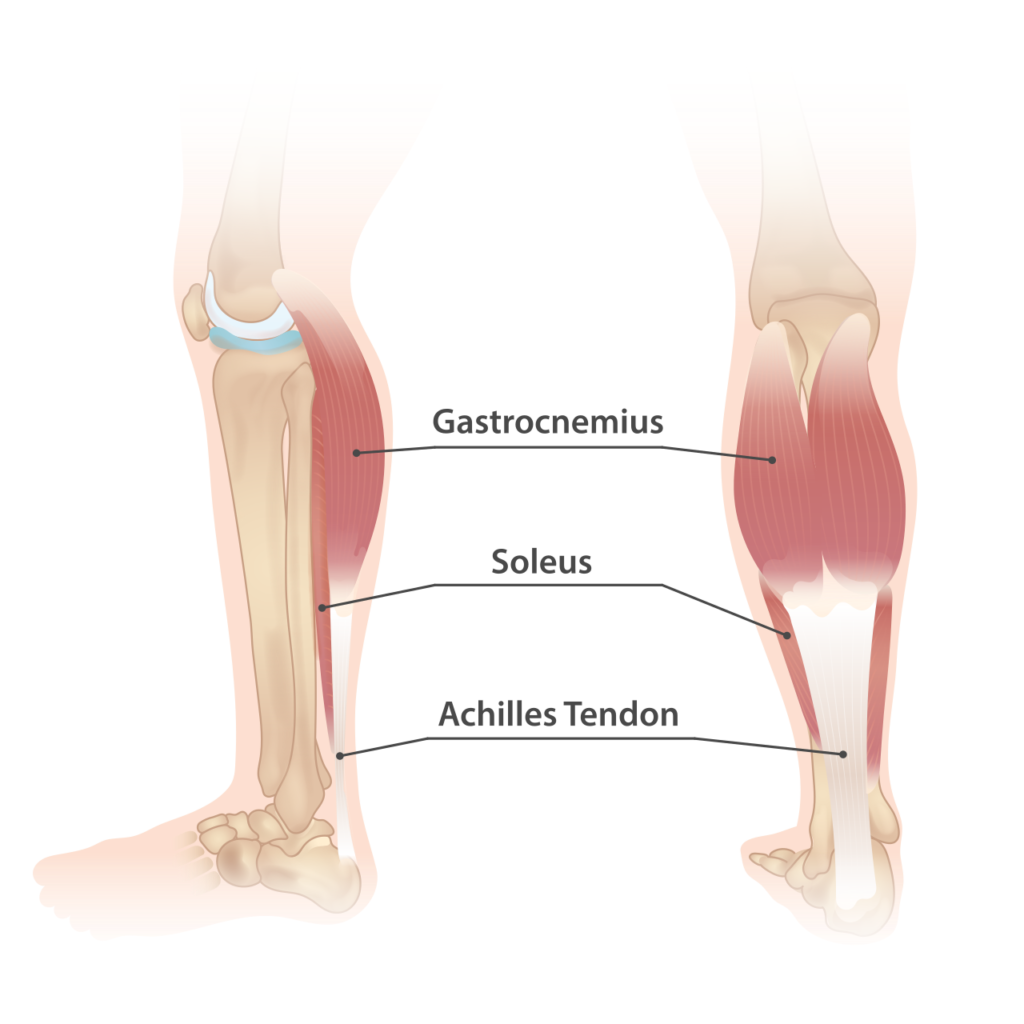
Your calf has two main muscles. The larger visible one at the back of the lower leg is the gastrocnemius. Sitting deeper and lower is the soleus. The gastrocnemius crosses both the knee and the ankle; the soleus crosses only the ankle.
When your knee is bent, the gastrocnemius is in a shortened position and cannot contribute much force. That leaves the soleus doing the work, which is the entire design intent.
Someone asked Hamilton directly whether the same benefits could be achieved standing. His answer was no, and his reasoning was specific. Standing puts roughly four times more load on the soleus. That heavier load reduces both range of motion and shortening velocity, which turned out to be central to how much energy the soleus uses. Standing also adds significant eccentric loading — the muscle resisting on the way down — which burns little energy while causing more stress. And the practical consequence: even trained athletes fatigue within minutes standing, whereas untrained participants sustained the seated version comfortably for four to five hours.
That last point reframes everything. This is not an exercise you do a set of. It is something you do for hours while getting on with your day.
Why calf raises are not the comparison
This is where the online confusion comes from, and it is an easy mistake. The movements look similar, and if you have spent time in a gym, a seated calf raise machine is the obvious reference point.
Hamilton addressed this when someone asked him exactly that. His answer was that they have different purposes and different methods. A calf raise is resistance training — seconds to minutes, to fatigue, with both a lifting and a lowering phase, and it does not rely on oxidative metabolism. That is what makes it good at building strength.
The soleus pushup is after something else: sustaining oxidative metabolism at a high rate for hours without fatigue. Different goal, different mechanism, different movement.
Hamilton has nothing against the alternative. He called calf raises one of his own favourite things to do, said he lifts every day, and noted there is no competition between the two — the soleus pushup only replaces time he would otherwise spend sitting inactive. So if you do calf raises, keep doing them. They are just not the thing that produced these blood glucose results.
Why it matters if you sit a lot
The framing that stayed with me is Hamilton’s point about time. People sit for roughly ten hours a day. Even a hard hour-long workout is about 10% of that — and muscle metabolism drops back down within about thirty seconds of the contractions stopping.
So the question behind the study was not “how do we get people to exercise more” but “what can raise muscle metabolism during all those hours nobody is exercising.”
That is relevant to me personally. I spent years as an event photographer editing until two or three in the morning. A great deal of my metabolic damage came from the sheer volume of sitting, not from missing gym sessions. Adding gym time later helped, but it never touched those sitting hours. This does.
How long should you actually do it for?
This is the question I had after trying it, and almost nobody answers it clearly.
The study’s answer is more than most people expect. The protocol had participants accumulating around 270 minutes across the day — four and a half hours — without letting more than four minutes pass without activity while seated. Not four and a half hours in one go, but rather a running total across every period of sitting.
If that sounds absurd, Hamilton’s own practical advice is far gentler: make the goal two minutes every time you sit down. That is it. He says people then keep going past two minutes without meaning to, and over weeks it accumulates.
There is no established minimum dose, but glucose was measurably lower within the first 30 minutes, so shorter sessions are clearly doing something. A sensible start is the 30 to 150 minute window after a meal, when your blood sugar is rising and when the effect was measured. Begin with a few minutes. Build up as it becomes automatic rather than chasing a target on day one.
On frequency: no maximum, no rest days. Hamilton reports over 60,000 contractions a day, seven days a week, and his team found no overuse injuries — including in participants in their nineties. The ankle handles it well, since it is the same range of motion as walking without the uneven ground.
What if it makes your calves tired?
It did mine. I tried it for ten to fifteen minutes and could definitely feel it, which seemed to contradict everything I had just read.
What follows is my own understanding of the research rather than something the study measured directly.
Given how fatigue-resistant the soleus is — untrained participants sustained it comfortably for three hours, some for four and a half — feeling tired within fifteen minutes most likely means other muscles are taking some of the load. Hamilton found exactly this: participants who thought about lifting their heels recruited the wrong muscles, and it looked identical from the outside. The larger calf muscle and the smaller helpers fatigue quickly. The soleus does not.
The second possibility is simply that it is new. Hamilton treats this as a motor skill to be learned, comparing it to throwing a ball or swinging a golf club, and expects people to keep improving over months. Awkward and effortful at first is normal.
Worth checking if you are feeling it: are you thinking “push down” rather than “lift up”? Toes under your knees rather than forward? Going too fast, when slow and full beats quick and shallow? Tensing the rest of your leg to help?
On next-day soreness: this should not cause the soreness you get from resistance training. If you wake up sore, you have most likely been recruiting other muscles. Not dangerous — it is the same soreness any unfamiliar movement produces — but a signal to revisit technique rather than push through. If you are experiencing actual pain, as opposed to mild stiffness, stop and get advice.
Do not overthink it
Having written all of that, I want to say the opposite for a moment, because it probably matters more.
Do not let getting the technique perfect stop you from doing it at all.
Hamilton is noticeably relaxed about this himself. His advice for people learning outside a research setting is to start with whatever feels safe and comfortable, put some music on, and enjoy it. He expects people to still be improving a year in. Nobody is meant to get this right in week one.
What could the downside be? If your technique is imperfect and you are recruiting some of the larger calf muscle, what have you actually done? A light calf exercise at your desk. Still muscle working, still burning some fuel, still better than sitting completely still — which is the thing this is actually competing against.
So start badly. Fine-tune as you go. The version you do imperfectly for months beats the version you never start because you were not sure where your foot should be.
Two caveats I would not wave away. This replaces nothing — not medication, diet, fasting or exercise. And if you are on blood sugar medication, watch your readings when you start, because anything that improves glucose clearance can interact with your doses. That is a conversation for your doctor rather than a blog.
Here is how to do it properly
Sit down. Knees bent, toes tucked under your knees rather than stretched out in front.
Push the ball of your foot down into the floor. Do not think about lifting your heel — the heel will rise on its own. Go to the top of whatever that gives you, smoothly and unhurried. Do not force extra height; if you have to strain, you have recruited the wrong muscle.
At the top, let the foot drop. No controlled lowering.
No weight. No standing. No burn.
Start with two minutes every time you sit down, especially in the couple of hours after a meal. Build from there as it becomes automatic. There is no daily maximum and no rest days needed.
If your calves get tired, you are probably using the wrong muscle — check you are pushing down rather than lifting, and slow it down. But do not agonise over any of it. Imperfect and consistent beats perfect and never begun.
The studies are small and this is early research. But it costs nothing, carries essentially no risk, and targets the part of the day that almost nothing else does. For someone managing Type 2 diabetes and sitting for a living, that is a reasonable thing to try.
If you want the fuller picture of what I have found actually works for managing blood sugar — how I structured 16:8 fasting, how I handled medication timing, and what the research says about insulin sensitivity — I wrote it all down in my guide.
And if you want to track how changes like this affect your own readings, this printable daily log was built for exactly that.
Sources
Dr Hamilton’s published replies to questions about technique — soleusmetabolism.org
The Efficacy of Soleus Push-Up in Individuals with Prediabetes: A Pilot Study. Sports, 2025.
University of Houston research announcement, 2022.
I am not a doctor. I write from personal experience as someone managing Type 2 diabetes, and from reading the published research. Nothing here is medical advice. Speak to your doctor before making changes that could affect your blood sugar or medication.